


You are standing in the shop with a boot in one hand and a low-cut trail shoe in the other. Both have sticky rubber, both look serious, and the price tags are close enough that money will not settle it. What actually separates them is how much structure you want under your feet, how much weight you are willing to carry, and what the ground looks like where you walk.
Neither wins outright. A stiff leather boot is miserable on a smooth, rolling trail in July. A thin mesh shoe is a bad joke on a boggy ridge in November. The trick is matching the footwear to the days you really go out, not the mountain you daydream about.
What Separates the Two
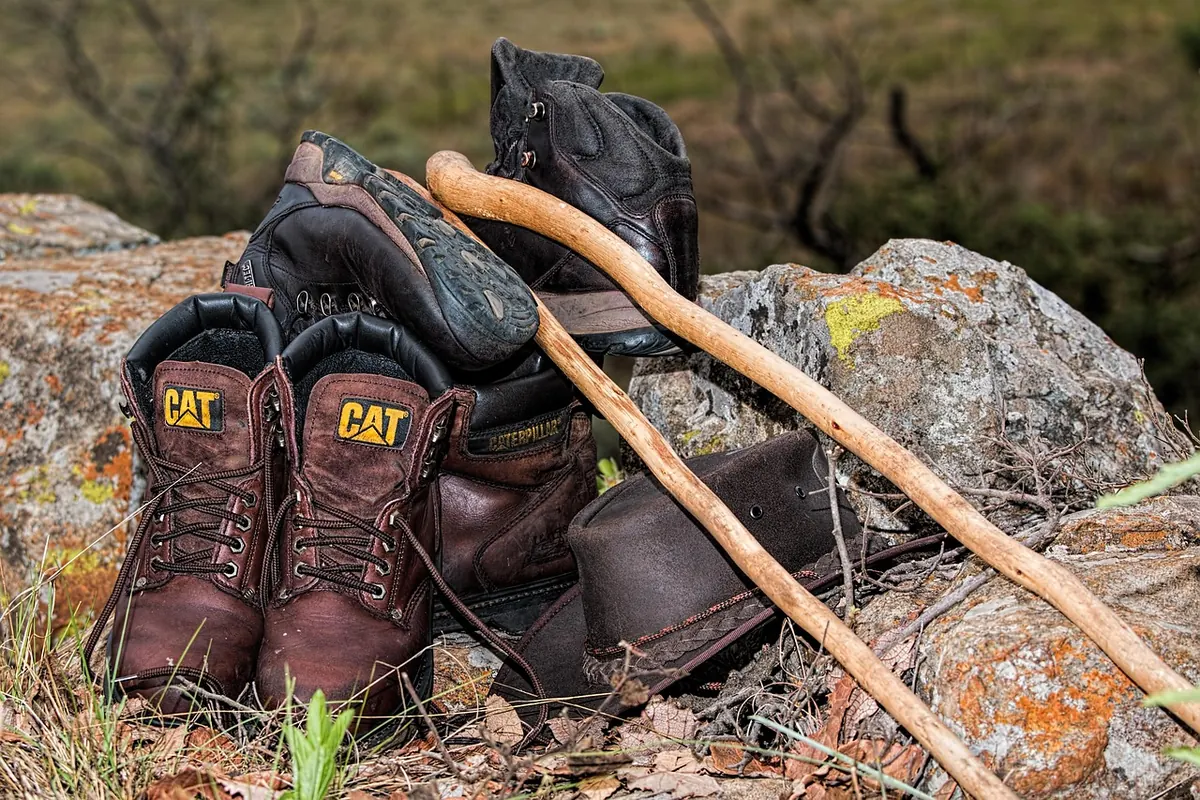
A hiking boot is mid- or high-cut, with an ankle collar, a stiffer midsole, often a shank inside the sole, deeper lugs, and more rubber wrapping the toe and heel. It is built to be planted. A trail shoe is low-cut and closer to a running shoe with a grippier sole, sometimes with a rock plate under the forefoot. It is built to keep moving.
Between them sits a messy middle: the light mid boot, the "fast hiking" shoe with a slightly stiffer sole. Plenty of people are happiest there. It is worth knowing the two extremes first, because everything else is a compromise along the same axis.
Support: What the Ankle Collar Does and Does Not Do
The collar is not a cast. It will not stop your ankle rolling if the sole and upper let the whole foot twist, and a tall boot laced loosely gives you almost nothing. What the collar does well is protect you from knocks: rock edges, scree, roots, the sideways swipe of a hidden stump. It also keeps grit and heather out, and it holds your heel in place on long descents.
Real support comes from the platform. A stiff midsole resists twisting on uneven ground and stops your arch from working overtime when you are carrying fifteen kilos. That stiffness is what your feet notice at hour six, especially on rough terrain where every step is a different angle.
Trail shoes trade that away deliberately. You feel the ground more, which is a delight on a well-made path and a chore on a boulder field. Your ankles and calves do more of the stabilising. For fit, strong walkers on light loads, that is a fine trade.
Weight: The Difference You Feel Every Step
Weight near your feet costs more than weight on your back. If you have ever hiked in heavy boots and then tried the same route in light shoes, you know the feeling: the pace lifts, the knees complain less on descents, and you take fewer shuffling steps at the end of the day.
A few hundred grams per pair sounds trivial on paper. Over several thousand steps, it is not. If your trips are mostly on decent trails and your pack is light, weight is the strongest argument for shoes. If your trips involve long days, rough ground and a heavy pack, the extra grams buy something real.
Weather: Staying Dry vs. Drying Out
Waterproof membranes keep rain, wet grass and shallow puddles out. They also keep sweat in, which means warmer feet in summer. And once water comes over the top of the collar, a lined boot holds it. In cool, damp conditions it can take a long time to dry, and a wet boot is heavy and cold the next morning.
Mesh trail shoes let water straight through. That sounds worse than it is. Cross a stream, walk ten minutes, and they drain and dry as your feet warm the fabric. Quick-draining shoes with thin, wool-rich socks are often more comfortable on a wet summer day than a sopping boot.
The short version: waterproof boots for cold, wet, splashy conditions where you are not going to wade. Breathable shoes for warm, wet conditions where you will. Add gaiters to either and you stretch the useful range considerably.
Terrain and Typical Use Cases
Think about the worst ground on your route, not the average. That is where footwear decisions get made.
- Maintained trails, dry weather, day hikes: trail shoes. Lighter, cooler, plenty of grip.
- Multi-day trips with a loaded pack on rough ground: boots. The stiffness pays for itself.
- Fast and light overnighters: trail shoes or a light mid boot, depending on how rough the path is.
- Shoulder-season hills, wet grass, cold wind: waterproof boots with a decent collar.
- River crossings, canyons, hot climates: quick-draining shoes, no membrane.
- Scree, boulder fields, off-trail travel: boots, or approach-style shoes with a stiff sole and a good toe rand.
- Winter hillwalking where crampons are needed: stiff boots built for the job — most trail shoes will not take them.
- Town-to-trail days and travel: trail shoes, since you can wear them on the train home.
If your year includes two or three of those rows, you are not being indecisive by owning both. Most regular walkers end up with a light pair for summer and a heavier pair for everything else.
Fitting and Testing Before You Commit
Fit beats category every time. A brilliant boot that rubs your heel is worse than an average shoe that fits. A few things worth doing in the shop, and again at home:
- Try them on late in the day, when your feet are at their largest, and wear the socks you hike in.
- Leave a thumb's width between your longest toe and the front of the shoe. On descents, your foot slides forward; a tight toe box means black toenails.
- Walk up and down a ramp or stairs. Feel for heel lift at the back and toe contact at the front.
- Check the width. If the upper bulges over the sole, the shoe is too narrow regardless of length.
- Wear them indoors for an hour or two, then on a short local walk before any big day out.
Lacing matters more than people expect. A heel-lock or runner's loop pulls your heel back into the pocket and reduces slipping on climbs. On long descents, loosen the lower laces slightly and keep the ankle firm.
How to Decide
Answer three questions honestly. How heavy is my pack? How rough is the ground? How wet will my feet get?
Light pack, decent trail, warm weather: buy trail shoes and spend the saved weight on a better rain jacket. Heavy pack, rough ground, cold and wet: buy boots that fit well and break them in gradually. Somewhere in the middle, pick the light mid boot and stop agonising.
Then go outside and use them. Footwear only proves itself on the hill, and the pair that suits your local paths will always beat the pair that suits someone else's idea of adventure.
Photo: stevepb / Pixabay
Related posts
More stories you’ll love reading